Open Veins - Tupi-Guarani Mythology ARPG
- Guilherme Martins

- 3 days ago
- 14 min read
Role: Senior Level Designer / Game Designer
Tools: Unreal Engine 5, Maya
Studio: 1% Games Studio
IP: Open Veins
Genre: ARPG
Platform: PC
Level Design System Breakdown
Part 1 - World Design: Macro Structure
Overview
Open Veins is an action RPG built on Tupi-Guaraní mythology - one of the richest and least-explored mythological traditions in game design. The world is structured as a living territory of sacred and corrupted lands, where indigenous cosmology shapes both the spatial logic and the narrative stakes. Overseas invaders are not merely enemies - they are a systemic environmental threat, and their presence is felt in every zone they occupy through visual degradation, displaced peoples, and corrupted sacred spots.
The open world is divided into distinct zones - each functioning as a unique node with its own mythological identity, spatial grammar, threat level, and role in the player's progression arc. Zones are not interchangeable. Each one has a personality rooted in Tupi-Guaraní lore that the player learns to read.
World Design Philosophy
The world was designed using two complementary frameworks applied simultaneously at the macro (world) and micro (zone) scale.
Oniscu's Linear / Multi-path / Open-World Framework
The world structure avoids the failure mode of open worlds: scatter enough POIs and hope players find them interesting. Instead, the world is divided into regions that apply an onion-layer structure - players move from bubble to bubble, experiencing an implicit progression curve regardless of which path they take between zones.
• Each zone exerts a magnetic pull on the player through visual distinctiveness, mythological reputation, and narrative hooks visible from adjacent areas
• Zones compete for player attention rather than demanding it. The player weighs distance, visible risk, narrative curiosity, and prior knowledge before committing to a zone
• Inside each zone, the multi-path model is applied: multiple routes through the space lead to the same progression beats, preserving the escalation curve regardless of player approach
•The 360° sandbox principle means zones must be readable and enterable from any direction - no zone has a single correct entry point
Oniscu's Exploration and Risk Zones Framework
The spatial grammar of each zone is built around the relationship between passability, visibility, and risk - the three variables that define how players read and commit to space.
•Hard edges (cliff faces, rivers, fortified walls) provide reliable directionality and clear zone boundaries
•Soft edges (dense forest, fog, sacred mist, cursed overgrowth) create risk bubbles - passable, but with unknown consequences that transform the player from predator to prey
•Every risk bubble has a Heart of the Hurricane. A calm anchor inside the danger zone that rewards committed exploration
•Vantage points (high ground with low passability) provide orientation resets and strategic reads of adjacent zones
•Leading lines (rivers, sacred paths, invasion roads) imprint directionality without UI, guiding movement through affordance
World Structure - Zone Network
The world is organized as a node network where each zone carries a distinct mythological and spatial identity. Zones are connected through natural corridors, sacred paths, and contested roads that reflect the ongoing conflict between indigenous territories and invader occupation.
Zone Hierarchy
• Aramandá Queimada - Safe Hub / Progression Anchor
◦ Central node of the player loop. Low threat, high systemic function.
• The Mourning Forest - Onboarding / Mid-risk Combat Zone
◦Introduction zone. Active conflict, environmental destruction, mechanic teaching through action.
• Iurupari's Territory - High-risk Exploration / Boss Zone
◦Corrupted space shaped by betrayal and occupation. Dungeon-driven boss confrontation.
Zone Relationships
•The Mourning Forest is the first active conflict zone and establishes the systemic threat of the invaders
•Iurupari's Territory is the consequence of that threat left unchecked: deeper, more corrupted, higher stakes
•Zones are visible to each other at boundaries, creating magnetic pull and narrative curiosity before the player commits
Macro Player Flow
Arrival and grounding:
•Player enters through Aramandá Queimada: safety, readability, orientation
•The Hub communicates the world's conflict state through environmental change and NPC testimony
•Distant zones are implied through sound, light, and NPC dialogue before the player sees them
First engagement - The Mourning Forest:
•Player is drawn to the forest by visible environmental destruction and NPC urgency
•Risk escalates as they move deeper: soft forest edges, enemy patrols, corrupted clearings
•Return to Hub recontextualises progression: the world has changed because the player acted
Escalation - Iurupari's Territory:
•The territory is visible from the forest - darker, more corrupted, more ominous
•Player enters prepared by mechanics, narrative context, and emotional investment built in prior zones
•Boss confrontation resolves the zone's narrative thread but deepens the world-level conflict
The player loop:
combat zone - return - upgrade - prepare - depart - deeper zone
World Escalation Curve
Following Oniscu's peaks-and-valleys model, the world is designed so that intensity rises across the zone network but is punctuated by deliberate recovery beats. Preventing emotional and mechanical exhaustion.
•Aramandá Queimada: valley: recovery, preparation, narrative absorption
•Mourning Forest entry: rising peak: urgency, new mechanics, active conflict
•Mourning Forest completion: descending beat: resolution, new knowledge, return
•Iurupari approach: sustained escalation: dread, anticipation, narrowing paths
•Boss confrontation: climax peak
•Post-boss return to Hub: final valley: world has shifted, player has changed
The curve is experienced across zones rather than within a single level. The Hub is the valley that makes every peak meaningful.
Part 2 - Zone Breakdowns: Micro Structure
Each zone below is documented as a standalone level design case study, applying the macro frameworks at the local scale. Every zone has a unique spatial grammar, threat profile, and mythological identity - but all share the same underlying design logic.
Zone 01 - Aramandá Queimada

Zone Identity
Aramandá Queimada is a scorched settlement. A community that has endured the invaders' first wave and survived. Its name carries both wound and resilience. Architecturally it reads as a space that has been rebuilt over ruins: the bones of destruction visible beneath the signs of recovery. Players feel the weight of what was lost and the determination of what remains.
In Tupi-Guaraní cosmology, fire is both destruction and transformation. Aramandá is not a place that survived fire. It is a place that was reborn through it. That cosmological logic informs every spatial decision: nothing in the hub is pristine, but everything is purposeful.
Zone Role in the World Structure
•Primary progression anchor: the node players return to between all other zones
•Emotional decompression space after high-intensity combat zones
•Systemic hub for upgrades, farming, NPC interaction, and skill experimentation
•Living world-state indicator: the hub visually evolves as the global conflict progresses
Spatial Logic - Risk Profile
Applying Oniscu's risk framework, Aramandá Queimada is a high passability / high visibility zone - the closest thing to a safe anchor in the risk taxonomy. Its edges are soft (damaged walls, overgrown perimeters) rather than hard, communicating openness and recovery rather than fortification.
•No soft-wall risk bubbles inside the hub: the zone itself is the safe interior of a wider risk bubble
•Visibility is maximised: open central plaza, cleared sightlines, readable NPC clusters
•Perimeter edges begin to transition toward soft-wall risk as the player moves toward zone boundaries: signalling the approach of conflict territory

Flow Structure
•Central anchor plaza - orientation, social, immediate readability
•NPC clusters positioned along natural circulation paths: players pass through progression without forced routing
•Farming zone connected directly to skill upgrade systems: loop is visible and rewarding
•Landmarks orient navigation within seconds of arrival
•Perimeter gradually becomes less safe: spatial transition signals departure toward risk
Player Flow
Arrival:
•Players enter after high-pressure gameplay - immediate safety is communicated through light, NPC activity, and low environmental tension
•Central landmark orients the player within seconds
Stabilisation:
•Recovery behaviours emerge naturally: inventory, upgrades, rest
•NPCs provide narrative updates that reflect world state changes
Experimentation:
•Farming zone rewards engagement and provides clear progression feedback
•Skill testing in low-pressure context builds mechanical confidence
Departure:
•The hub's perimeter edge signals the transition back to risk
•Players leave with upgraded capabilities, narrative context, and directional purpose
Design Shortcomings & Iteration
•Early iterations: players treated the hub as a pass-through rather than a destination
◦Fix: reinforced gathering nodes, embedded narrative beats in circulation paths
•Farming system felt disconnected from core progression
◦Fix: directly linked farming rewards to skill unlock gates
•Navigation friction between NPCs slowed pacing
◦Fix: grouped NPC clusters by function along natural movement corridors
•Narrative spaces ignored when placed off critical routes
◦Fix: embedded all primary narrative delivery into commonly traversed spaces

Delivered Experience
combat zone - return - upgrade - prepare - depart
The hub became a systemic pillar of the player loop rather than a rest stop. Players return not just for progression. But for the sense that this place is worth protecting.
Zone 02 - The Mourning Forest

Zone Identity
In Tupi-Guaraní cosmology, forests are living beings. Presences with memory, relationship, and agency. The Mourning Forest is a sacred space that has been wounded. Invasive machinery is actively destroying its root systems, displacing its spiritual guardians, and severing the connections between the living world and the spirit world. The player enters not as an explorer but as a respondent. The forest is already calling for help.
The name is earned. The forest mourns. And the player is the answer to that mourning.
Zone Role in the World Structure
•First active conflict zone: establishes the invaders as a systemic environmental threat
•Primary onboarding zone: new mechanics taught through action, not exposition
•Gateway zone: bridges the safety of Aramandá and the deeper corruption of Iurupari's Territory
•Multi-path structure applied at zone scale: multiple destruction objectives approachable in any order
Spatial Logic - Risk Profile
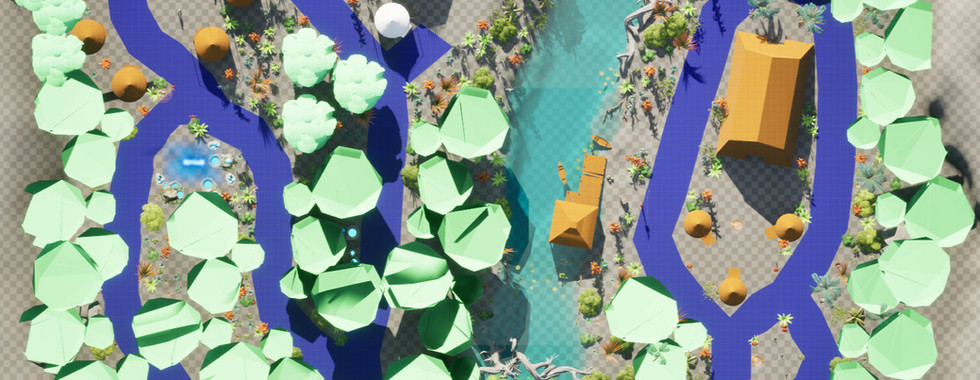
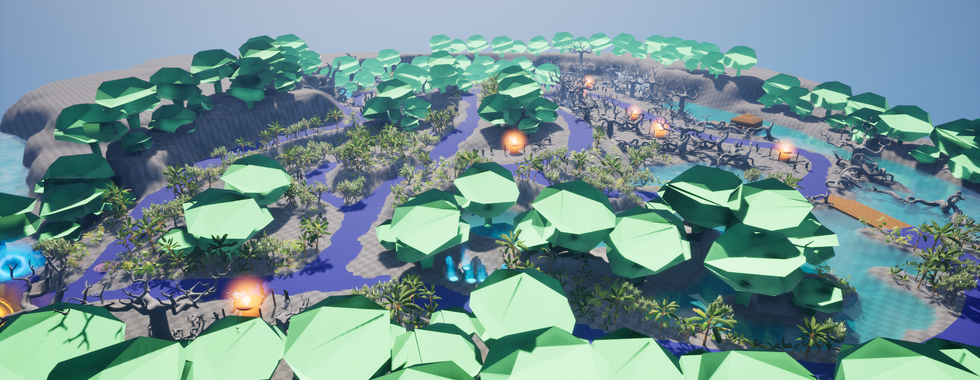
The Mourning Forest is built as a layered risk zone. Applying Oniscu's soft-wall framework, the forest itself is the soft wall. Visually dense, partially obscured, and generating anxiety at its edges. Players approach the zone from Aramandá along a clear leading line (a riverside path), then transition into increasing soft-wall density.
•Forest canopy functions as soft wall: passable, visibility-reducing, risk-escalating
•Clearings near invasion machinery function as aggressive spaces: high visibility but high enemy density
•Untouched deep forest pockets function as Hearts of the Hurricane: calm spaces inside the risk bubble rewarding committed exploration
•River edges provide leading lines and safe traversal corridors between conflict zones
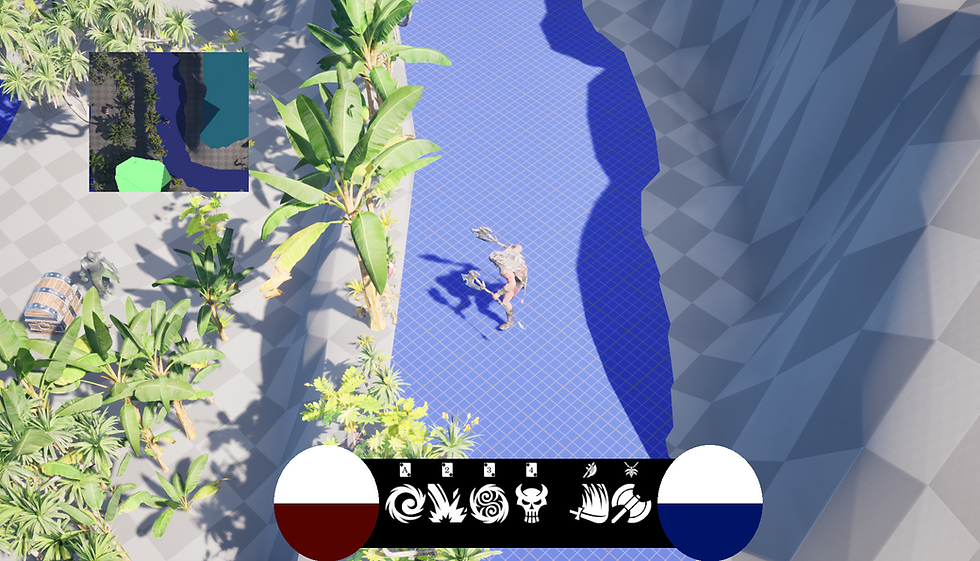
•Vertical parallax layers reinforce depth perception in top-down view: spatial hierarchy readable without UI

Flow Structure - Multi-path Applied
The zone applies Oniscu's multi-path model: a golden path establishes narrative direction, but destruction objectives can be approached in any order. Every path leads to the same progression beat. The escalation curve holds regardless of player route.
•Golden path: guides players toward primary destruction objectives and key narrative encounters
•Destruction loops: side routes allow players to disable invasive weapons in different sequences
•NPC pockets: placed off the main path to reward exploration with narrative and resources
•Mechanic introduction zones: safe forest clearings where portals and new systems are encountered first
•Reinforcement loops: all paths reconnect to the main route, preserving pacing continuity
•Final convergence: all routes merge at a high-pressure space where combat, destruction, traversal, and NPC support combine
Player Flow
Entry:
•Forest already under pressure. Environmental damage communicates urgency before combat begins
•Player is reactive, not exploratory. The space demands response
First contact:
•New enemy archetypes introduced in readable, low-pressure forest clearings
•Invasive machinery becomes visible as a destruction objective
Exploration phase:
•Multiple routes open toward destruction objectives
•NPC presence emerges through interaction rather than cutscenes
Mechanics discovery:
•Portals, traversal opportunities, and interactive world elements introduced in safe contexts first
•Each system appears alone before being recombined with combat
Mid-escalation:
•Enemy resistance increases around defended machinery
•Approach options create tactical decision-making: terrain, flanking, verticality
Narrative reveal and ally introduction:
•A new character is introduced. Reframing the conflict from isolated survival to organised resistance
•The player leaves with new mechanical knowledge, expanded combat vocabulary, and narrative direction
w-pressure forest clearings
•Invasive machinery becomes visible as a destruction objective
Exploration phase:
•Multiple routes open toward destruction objectives
•NPC presence emerges through interaction rather than cutscenes
Mechanics discovery:
•Portals, traversal opportunities, and interactive world elements introduced in safe contexts first
•Each system appears alone before being recombined with combat
Mid-escalation:
•Enemy resistance increases around defended machinery
•Approach options create tactical decision-making: terrain, flanking, verticality
Narrative reveal and ally introduction:
•A new character is introduced. Reframing the conflict from isolated survival to organised resistance
•The player leaves with new mechanical knowledge, expanded combat vocabulary, and narrative direction
Encounter Logic
•Weapon defense encounters: enemies protect machinery, forcing positional decisions
•Territory pressure: enemy placement reinforces that the forest is occupied, not just patrolled
•Destruction as combat rhythm: pressure - action - relief - discovery
•System layering: early encounters introduce mechanics individually; later encounters recombine them
◦portals + enemy pressure + environmental hazards in the same space
Environmental Storytelling
•Forest degradation visible near invasive weapons - the land is dying in measurable proximity to the machinery
•Untouched zones contrast with corrupted clearings - spatial contrast communicates the invaders' progress
•NPC displacement and resistance visible in prop placement and spatial positioning
•Portals and foreign technology suggest expanding occupation - this is not a raid, it is a settlement
Design Shortcomings & Iteration
•Early onboarding too abrupt. New systems appeared before players had spatial grounding
◦Fix: extended safe introduction zones, introduced mechanics in controlled contexts before combat pressure
•Destruction objectives felt disconnected from each other
◦Fix: restructured as a legible multi-path system with visible connections between objectives
•Ally introduction felt arbitrary
◦Fix: embedded ally encounter at a narrative convergence point earned by prior exploration

Delivered Experience
The player is not observing destruction. They are actively interrupting it.
Players leave the Mourning Forest with agency, mechanical confidence, and a personal stake in the world's survival.
Zone 03 - Iurupari's Territory


Zone Identity
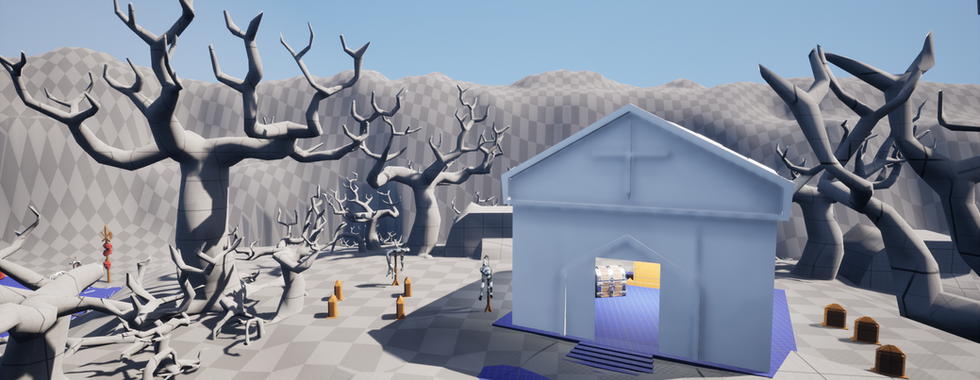
Iurupari is one of the most complex figures in Tupi-Guaraní mythology. A spirit associated with transgression, forbidden knowledge, and the consequences of betrayal. His territory is not simply an enemy camp. It is a sacred space that has been turned against itself. The invaders did not conquer this land by force alone. They were invited in, through a betrayal that fractured the spirit world.
The player who enters this zone is not facing an external threat. They are entering the wound. Every spatial element communicates corruption from within: sacred geometry distorted, spiritual markers inverted, natural growth used as camouflage for occupation.
Zone Role in the World Structure
•Highest-risk zone in the current world structure: consequence of unchecked invasion
•Dungeon-driven boss confrontation as zone climax: spatial preparation for the final confrontation
•Narrative resolution zone: Iurupari's betrayal is understood through space, not exposition
•Mechanical recombination zone: all systems introduced in prior zones are tested together

Spatial Logic - Risk Profile
Iurupari's Territory is the most aggressive application of Oniscu's risk framework. The entire zone is a sustained risk bubble with high soft-wall density, limited safe corridors, and a single Heart of the Hurricane. A corrupted sacred clearing at the dungeon's entrance that offers a final preparation beat before the boss confrontation.
•Zone entry: soft-wall edges: corrupted vegetation and sacred mist reduce visibility, generate anxiety, transform player from predator to prey
•Mid-zone: chokepoints and terrain create sustained positional pressure: no safe open spaces
•Dungeon approach: hard edges narrow the path: architecture compresses as the boss draw closer
•Heart of the Hurricane: a corrupted sacred clearing before the dungeon entrance: silence, dread, final preparation
•Boss arena: maximum hard-edge containment: the zone resolves into a single high-stakes space
Vantage points are deliberately rare in this zone. The player cannot read the territory safely. Orientation must be earned through movement and risk.
Flow Structure - Descent Model
Unlike the Mourning Forest's multi-path freedom, Iurupari's Territory uses a structured descent model. Paths branch for exploration but consistently funnel toward the dungeon. The zone teaches the player that in this territory, all roads lead to confrontation.
•Golden path: environmental corruption intensifies as a directional gradient: darker, denser, more hostile
•Secondary loops: optional encounters and hidden narrative fragments reward observation and risk
• Hidden paths: agency is preserved but the cost of exploration is higher here than anywhere else
•Encounter clusters: high-pressure sequences alternated with moments of silence and anticipation
•Final convergence: all routes narrow to the dungeon entrance: pacing tightens, anticipation builds

Player Flow
Entry - hostile reading:
•Players enter a corrupted natural area: environmental storytelling establishes tone before combat
•Early routes introduce navigation choice under light combat pressure
•The forest edge communicates: you are no longer safe
Exploration under pressure:
•Branching paths allow choice but no path is without risk
•First tension spikes emerge through controlled encounter placement
Mid-escalation:
•Chokepoints and terrain create sustained decision-making pressure
•Recovery spaces appear between high-risk sequences, but they are shorter and less safe than in prior zones
•Mechanics introduced in the Mourning Forest are recombined here under higher pressure
Dungeon approach:
•Corruption intensifies visually and spatially, the sacred geometry of the dungeon entrance is visible ahead
•Navigation narrows, the player understands they are committed
Heart of the Hurricane - pre-boss beat:
•A corrupted sacred clearing offers a moment of silence before the final confrontation
•The player is mechanically and emotionally prepared, or they should have been
Boss confrontation:
•The dungeon resolves all prior zone preparation into a single space
•Iurupari is not a surprise. The zone has been building toward him from the first step inside
Encounter Logic
•Chokepoints create tension and force positional awareness, terrain is a weapon for both sides
•Verticality shapes engagement distance and approach options
•Recovery spaces placed deliberately after high-pressure sequences, pacing is a design choice, not a gap
•Optional encounters offer risk-reward choices, deeper narrative for greater danger
•Enemy placement reinforces navigation: enemies are where players should pay attention
Combat rhythm:
•tight, high-risk engagement - silent traversal - anticipation - confrontation

Environmental Storytelling
•Sacred site markers inverted or corrupted , the land itself has been spiritually occupied
•Spatial contrast between natural Tupi-Guaraní sacred geometry and invasive occupation structures
•Iurupari's influence visible as a spatial gradient, corruption deepens as players approach his dungeon
•Prop placement and decay communicate the history of the betrayal without text
•Boss arena design reflects Iurupari's dual nature, the space is both sacred and violated
Design Shortcomings & Iteration
•Early boss lead-in felt disconnected from prior zone experience
◦Fix: redesigned dungeon approach as a spatial preparation sequence using mechanics introduced in the Mourning Forest
•Soft wall risk bubbles caused orientation failure, players felt lost, not pressured
◦Fix: introduced subtle leading lines (corrupted sacred paths, river edges) to maintain directionality within the risk zone
•Boss arena too abrupt after open zone exploration
◦Fix: introduced the Heart of the Hurricane beat, a deliberate silence space before the dungeon entrance
•Optional narrative fragments were too hidden, rewarded only the most thorough players
◦Fix: repositioned key lore fragments on secondary paths rather than hidden dead ends, discovery without excessive difficulty

Delivered Experience
The player does not fight Iurupari. They understand him - and then they fight him.
Players who complete this zone leave with narrative resolution, mechanical mastery, and a sense that the world's wound is both deeper and more complex than they initially understood.
Part 3 - Design Systems Applied
Framework Application Summary
Oniscu's Linear / Multi-path / Open-world Model:
•World divided into distinct nodes with independent magnetic pulls on the player
•Onion-layer progression structure ensures escalation curve holds across the full world
•Multi-path model applied at zone scale, freedom of approach, and consistency of progression
•360° entry principle applied to all zones, no single correct approach angle
Oniscu's Exploration and Risk Zones Framework:
•Passability / Visibility / Risk taxonomy applied to all zone boundaries and interior paths
•Soft-wall edges used to create risk bubbles, anxiety, and commitment decisions
•Heart of the Hurricane principle applied in all high-risk zones. A calm anchor inside every danger space
•Leading lines embedded in natural geography: rivers, sacred paths, invasion roads, provide directionality without UI
•Vantage points placed at zone boundaries to support orientation resets and inter-zone reads
Mythological Design Logic
The Tupi-Guaraní mythological framework is not decoration. It is the spatial logic of the world.
•Sacred sites define the spatial hierarchy, they are the landmarks of the world
•Corruption gradients follow mythological logic, spaces sacred to Iurupari corrupt differently from spaces sacred to natural spirits
•The invaders' occupation is spatially legible, players read the invasion through architecture, materials, and environmental degradation
•The player's movement through the world mirrors the mythological journey, from safety, to conflict, to understanding, and to resolution
Escalation Curve Across Zones
•Aramandá Queimada - Valley (recovery, grounding, safety)
•Mourning Forest Entry - Rising Peak (urgency, new systems, active conflict)
•Mourning Forest Completion - Descending Beat (resolution, new knowledge, return)
•Iurupari Approach - Sustained Escalation (dread, narrowing paths, anticipation)
•Boss Confrontation - Climax Peak
•Post-boss Return - Final Valley (world shifted, player changed)
Open World Design • ARPG • Zone Design • Tupi-Guaraní Mythology • Environmental Storytelling • Spatial Narrative • Encounter Design • Exploration & Risk Design • Multi-path Level Design • World Building • Cognitive Mapping • Top-down Design • Unreal Engine 5