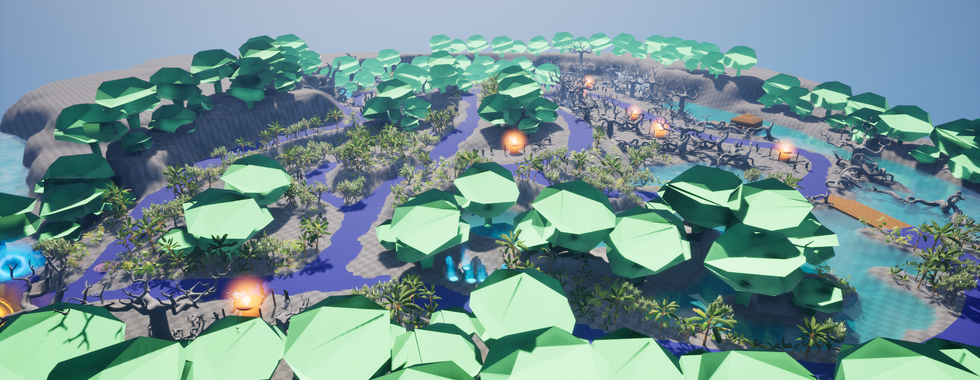
Open Veins - The Mourning Forest
- Guilherme Martins
- 4 days ago
- 5 min read

Updated: 11 hours ago
Role: Level Designer / Game Designer
Tools: Unreal Engine 5, Maya
Summary
- Overview: This level focuses on introducing new gameplay elements through exploration, combat, and player agency. Players enter a forest region under threat from overseas invaders whose weapons are actively destroying the environment. The experience is structured around fast pacing, constant decision making, and the discovery of new mechanics, NPCs, and lore. As players progress, they uncover the source of the destruction, interact with new characters, and gain access to tools and systems that expand both gameplay and narrative understanding.
- Briefing: Introduce new NPCs, mechanics, and obstacles through gameplay rather than exposition. Encourage player agency by allowing multiple approaches to objectives and encounters. Create a fast-paced level rhythm driven by exploration, combat, and destruction objectives. Establish clear primary goals centered on destroying invasive weapons affecting the forest. Reveal lore progressively through environmental storytelling and character interaction. Introduce a new ally character who supports the player’s long-term journey and conflict. Present new systems such as portals, enemy archetypes, and interactive world elements
- Design Ownership: Designed the level layout to support high pacing and continuous player engagement. Structured objectives around locating and destroying enemy weapons across the environment. Introduced new NPC types and encounter setups to expand gameplay possibilities. Integrated environmental storytelling to show the impact of the invaders on the forest. Implemented discovery moments tied to lore, including new technologies, portals, and weapons. Designed spaces that support multiple approaches, reinforcing player agency in combat and traversal. Created progression beats leading to the introduction of a new ally character. Iterated on combat flow, readability, and objective clarity through playtesting
The Level Breakdown
Briefing
Create a fast-paced onboarding level that introduces new gameplay systems through action rather than exposition.
The level needed to:
teach mechanics through interaction, not tutorials
reinforce player agency through multiple approaches and paths
establish the invaders as an active systemic threat
structure progression around destroying invasive weapons
introduce new NPCs, portals, enemy archetypes, and world interactions
expand narrative understanding through discovery and environmental storytelling
A key pillar was making the level feel reactive. The player is not observing destruction. They are actively interrupting it.

Flowchart
The layout supports both urgency and agency.
Golden path:
Guides players toward major destruction objectives and key encounters.
Destruction loops:
Side routes allow players to disable invasive weapons in different orders.
NPC pockets:
Placed off the main path to reward exploration and discovery.
Mechanic introduction zones:
Safe spaces where portals, traversal elements, and interactions are learned.
Reinforcement loops:
Paths reconnect to the main route, maintaining pacing continuity.
Final convergence:
All routes lead back into a high-pressure area where systems combine:
combat, destruction, traversal, and NPC support.
Player Flow
The experience is structured as a forward push into a living conflict zone.
Entry:
Players enter a forest already under pressure from invasive machinery. Environmental damage communicates urgency before combat begins.
First contact:
Early encounters introduce new enemy archetypes in readable scenarios. Weapons destroying the environment become visible objectives.
Exploration phase:
Players choose routes to approach destruction points. NPC presence begins to appear through interaction rather than cutscenes.
Mechanics discovery:
Portals, new traversal opportunities, and interactive world elements are introduced gradually. Each system appears in a safe context before being recombined with combat.
Mid escalation:
Enemy resistance increases around destruction objectives. Multiple approach options create tactical decision making.
Narrative reveal:
Environmental storytelling and NPC interactions clarify the invaders’ impact and motivations. The player begins to understand the scale of the conflict.
Ally introduction:
A new character is introduced as a support figure for the long-term journey. Their presence reframes the conflict from isolated survival to ongoing resistance.
Exit state:
The player leaves the area with:
new mechanical knowledge
expanded combat vocabulary
narrative direction
a sense of agency in changing the world

Encounter logic
Encounters are built around objectives rather than isolated combat arenas.
Weapon defense encounters:
Enemies protect invasive machinery, forcing positional decisions.
Territory pressure:
Enemy placement reinforces the idea that the forest is occupied.
Multi-approach combat:
Terrain, flanking routes, and vertical variation allow different playstyles.
Destruction as combat rhythm
Destroying weapons creates pacing shifts:
pressure - action - relief - discovery.
NPC-supported engagement:
Some encounters introduce allies or non-combat characters influencing player decisions.
System layering:
Early encounters introduce mechanics individually.
Later encounters recombine them:
portals + enemy pressure + environmental hazards.
Environmental storytelling and world building
Narrative is communicated through systemic impact.
forest areas visibly degrade near invasive weapons
prop placement shows rapid industrial intrusion
spatial contrast highlights untouched vs corrupted nature
NPC positioning reflects displacement and resistance
portals and foreign technologies suggest expanding occupation
The player understands the conflict by moving through it.
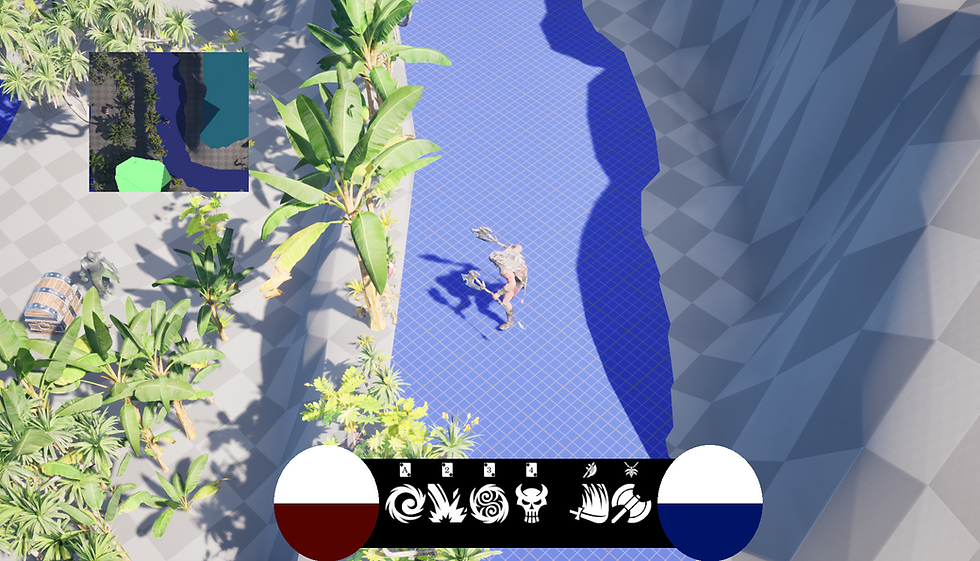
Parallax in a top-down perspective
To reinforce depth and progression in a top-down view, I used layered environmental composition with parallax:
foreground elements move at a different rate than background layers during player traversal
distant environmental silhouettes and structures reinforce directionality
vertical stacking of terrain, props, and architecture creates readable depth planes
This approach:
strengthens spatial hierarchy
improves orientation during exploration
adds visual storytelling without UI guidance
makes progression feel like moving deeper into territory rather than across a flat map
The parallax layer became a navigation tool, not only a visual one.
Onboarding through space
Instead of explicit tutorials, mechanics are learned through placement and repetition.
new enemy archetypes appear first in low-pressure spaces
portals are introduced in safe traversal contexts
destruction objectives start isolated before appearing in defended areas
NPC interactions begin optional before becoming central
This creates confidence before complexity.

Design Shortcomings
Early iterations exposed onboarding and pacing issues.
players rushed objectives without understanding new mechanics
destruction tasks felt repetitive in early layouts
NPC presence lacked impact and was sometimes ignored
combat density created fatigue in mid-sections
portals were discovered too late to influence early decisions
environmental damage did not initially communicate urgency strongly enough
The level risked becoming a sequence of tasks rather than a learning experience.
Iterative Process
Adjustments focused on clarity, pacing, and system readability.
repositioned portals earlier to influence navigation decisions
varied destruction objectives using terrain and enemy composition
moved NPC interactions closer to exploration loops
introduced recovery spaces between high-pressure encounters
strengthened visual contrast around invasive weapons
added environmental cues guiding players toward mechanic discovery
refined encounter placement to support multiple approaches
Iteration and playtesting informed each structural change.
Delivered Experience
The final level functions as a systemic onboarding experience.
Players learn by acting, not reading.
The level delivers:
fast-paced, objective-driven exploration
strong player agency in combat and navigation
readable introduction of new mechanics and enemy archetypes
environmental storytelling tied to gameplay impact
meaningful NPC introduction supporting long-term narrative
destruction objectives integrated into pacing and progression
The project demonstrates:
onboarding through spatial design
systemic introduction of mechanics
objective-based encounter construction
pacing control in high-intensity environments
environmental storytelling tied to player action
player agency as a core structural pillar
The space teaches, escalates, and expands the game simultaneously, positioning the player as an active force within the conflict rather than a passive observer.
Gameplay Onboarding • Player Agency • Fast-Paced Level Design • Objective-Driven Exploration • Environmental Storytelling • NPC Introduction • Combat Encounters • Lore Integration • New Mechanics Introduction • World Building