Fortnite UEFN - Hotspot Design

Role: Senior Level Designer / Game Designer
Tools: Unreal Engine / Fortnite UEFN
Studio: Epic Games
IP: Fortnite UEFN
Gender: Third Person Shooter / Battle Arena
Platform: PC

Summary
Overview: King of City is a PvP-focused urban combat map designed to blend fast-paced team deathmatch gameplay with stealth-oriented tactics within a stylized Japanese-inspired cityscape. The map emphasizes verticality, cover density, and spatial awareness, allowing players to choose between aggressive combat and stealth-based ambush playstyles. The level supports constant movement, repositioning, and tactical decision-making, encouraging players to read the environment and use space intelligently rather than relying solely on reflex-based combat. The arena seamlessly layers dynamic NPC pressure on top of player-versus-player encounters, creating varied pacing rhythms and forcing adaptive tactical responses. With rooftop networks, dense alleyway systems, and multi-level interiors, the map rewards spatial mastery and environmental exploitation over raw mechanical skill.
Briefing: Encourage strategic movement and ambush gameplay through verticality, elevation changes, and sightline segmentation. Support both stealth and aggressive PvP playstyles with distinct spatial zones tailored to each approach. Create a readable urban arena with clear combat zones, traversal routes, and visual landmarks enabling navigation mastery. Maintain dynamic pacing and tension by mixing player-versus-player combat with NPC pressure waves that force repositioning and prevent static gameplay. Balance fair competition through symmetrical layout design while preserving player agency in tactical decision-making.
Design Ownership: Designed the full urban layout from initial blockout through final playable iteration. Structured rooftops, alleys, interiors, and vertical routes to support stealth infiltration and flanking maneuvers. Implemented NPC wave systems using Verse scripting to add environmental pressure during downtime between PvP encounters. Balanced the map using symmetrical zone layouts and clearly defined combat areas to ensure fair competition across team spawns. Integrated UEFN traversal mechanics (mantling, climbing, vaulting, repositioning paths) to enable fluent vertical navigation. Utilized Verse scripting and UEFN devices to control spawn distribution, NPC behavior patterns, and dynamic combat flow regulation.
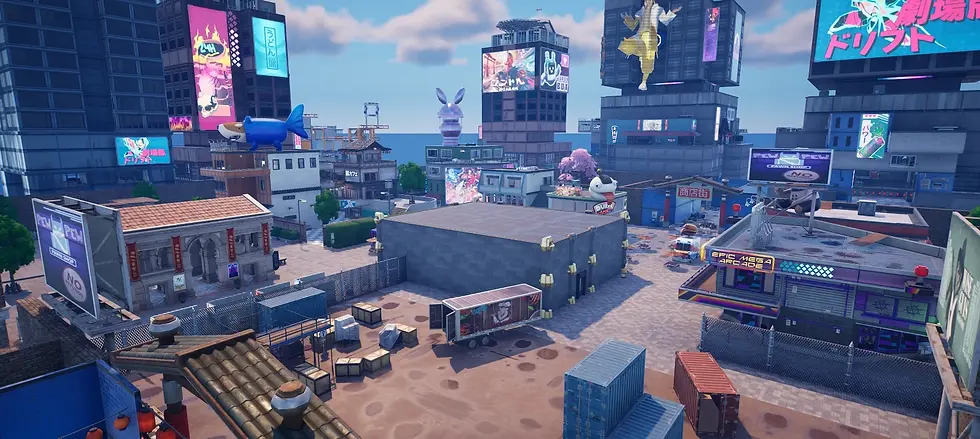
The Map Breakdown
Briefing
Design a fully playable urban deathmatch arena centered on playstyle diversity, environmental mastery, and adaptive tactical decision-making under dynamic pressure.
The map was built to:
Support multiple viable playstyles (aggressive push, mid-range trading, stealth ambush, defensive fortification)
Create a readable Japanese-inspired urban environment that communicates positional hierarchy and threat zones
Encourage constant vertical and horizontal repositioning through rooftop networks, alley systems, and interior routes
Balance player-versus-player combat with NPC pressure to force dynamic decision-making and prevent static camping
Maintain narrative cohesion through environmental storytelling and visual landmark clarity
Enable 1v1 skirmishes through 8v8 team engagements through balanced spawn distribution and zone scaling
The core pillar was adaptive playstyle expression.
Every position needed to ask the player: engage aggressively, hold a strongpoint defensively, reposition stealthily, or adapt to incoming NPC pressure?
Flow Structure
The map is built around interlocking vertical and horizontal combat zones rather than linear progression.
Central Hub Zone serves as the high-risk contested area where aggressive combat converges
Rooftop Network creates elevated sightlines enabling overwatch and long-range positioning
Alleyway System provides low-profile stealth corridors with sightline breaks and ambush opportunities
Interior Multi-Levels offer close-quarters battlegrounds and vertical flanking routes
Transition Zones connect major combat areas, enabling tactical rotation and regrouping
NPC Spawn Points distributed across zones to create dynamic pressure independent of player positioning
This structure ensures players must develop fluency across multiple engagement ranges, elevation tiers, and stealth/aggression decision points.
Player Flow
Entry/Spawn:
Teams spawn at balanced mirror-position locations across the map
Initial spawns provide brief safety window before immediate environmental pressure
Early sightlines encourage rapid engagement decision-making
Spawn proximity to multiple playstyle zones (aggressive route, stealth route, defensive strongpoint)
Early Engagement Phase:
First team encounters occur at medium-range in contested central zones
Players begin learning map geography, sightline patterns, and cover positioning
Rooftop and alleyway routes become apparent through visual exploration
Early NPC wave introduces environmental pressure forcing repositioning
Strategic Positioning:
Teams develop zone control strategies and strongpoint defense tactics
Stealth-oriented players identify ambush routes and flank corridors
Aggressive players establish dominant positions and trade-route control
Defender players fortify interior positions with overlapping cover angles
NPC pressure creates decision windows forcing tactical adaptation
Vertical Mastery Phase:
Players exploit rooftop networks for overwatch and repositioning
Interior multi-level routes become natural ambush points
Mantling and climbing mechanics enable unexpected approach vectors
Height advantage becomes tactical currency in positioning hierarchy
Mid-Game Escalation:
Combat density increases as teams converge on central zones
NPC wave intensity escalates, forcing coordinated team repositioning
Safe positions become scarcer; constant movement becomes necessity
Players must balance PvP threat assessment with NPC pressure awareness
Late-Game Tension:
Safe zones disappear; entire map becomes contested
NPC density reaches maximum, creating chaotic multi-threat environment
Survival depends on spatial mastery, route knowledge, and team coordination
Positioning mistakes have immediate consequences from multiple threat vectors

Engagement Logic
Encounters are designed as multi-dimensional tactical puzzles balancing PvP and PvE pressure.
Sightlines structured to support medium-to-long-range trading without enabling untouchable sniper dominance
Cover density enables aggressive flanking while providing retreat options for repositioning
Elevation changes create natural positioning hierarchy with meaningful contest routes (no untouchable high-ground)
Stealth corridors offer alternative approach vectors that reward environmental awareness
NPC wave patterns force predictable repositioning windows, creating opportunity for ambush setup
Spawn distribution ensures teams face equivalent threat assessment and positioning opportunities
The player learns that environmental awareness, adaptive playstyle selection, and team coordination matter as much as individual mechanical skill.
Environmental Design Philosophy
Gameplay meaning is conveyed through urban architecture and spatial hierarchy rather than explicit guidance.
Central plaza geometry communicates the contested high-value zone through open exposure
Rooftop silhouettes indicate elevated sightlines and overwatch positioning options
Alleyway compression suggests stealth corridors and ambush-friendly geometry
Neon signage and Japanese aesthetic reinforce thematic identity and navigation landmarks
Interior lighting indicates safety pockets and flanking route accessibility
NPC spawn markers become recognizable through repeated encounters, aiding threat prediction
The map is understood through play, experimentation, and spatial familiarity - not tutorial exposition.

Design Shortcomings
Playtesting and player feedback revealed several critical structural issues during development:
Unbalanced Playstyle Distribution: Early layouts favored aggressive combat positioning, leaving stealth-oriented players with limited viable routes and weak ambush opportunities
Dominant Spawn Positions: Certain team spawns provided inherent positional advantages, creating systematic fairness issues across extended matches
NPC Pressure Inconsistency: Wave timing felt arbitrary and disconnected from PvP pacing, sometimes creating overwhelming pressure spikes and other times feeling irrelevant to combat flow
Vertical Navigation Confusion: Rooftop networks lacked clear visual hierarchy, causing players to get lost or miss intended traversal routes
Stealth Zone Vulnerability: Intended ambush corridors had excessive sightline penetration, preventing stealth setups and forcing direct combat engagement
Contested Zone Choke-Points: Central areas compressed too heavily, creating spawn-camping vulnerability rather than distributed engagements
Interior Route Dead-Ends: Multi-level interiors contained paths that led to isolated positions without escape routes, punishing exploratory players
Critical Realization: The map initially played like disconnected combat pockets rather than a unified tactical arena balancing multiple playstyles.
Iterative Process
Iteration focused on achieving playstyle equity and improving NPC-PvP integration:
Primary Restructuring:
Redistributed spawn points to mirror-symmetrical positions, eliminating systematic positional advantages
Expanded stealth corridors with enhanced sightline breaks (elevated planters, building angles, neon signage placement)
Added dedicated ambush zones with controlled sightline access and multiple escape routes
Refined rooftop network with clear visual hierarchy and navigation landmarks (colored railings, signage, elevation terracing)
Repositioned contested central zone from tight choke-point to distributed plaza design with multiple entry vectors
Secondary Refinements:
Calibrated NPC wave timing to sync with natural player repositioning cycles, creating synergistic pressure rather than arbitrary interruption
Implemented variable NPC behavior (ranging, patrolling, ambushing) to prevent predictable threat patterns
Adjusted cover density in stealth zones to support crouching/hiding without creating unchallenged camping spots
Enhanced vertical route clarity through mantling point placement and visual progression indicators
Added interior shortcut routes with balanced risk/reward (quick repositioning but exposure vulnerability)
Created asymmetrical micro-zones within symmetrical macro-layout to preserve playstyle variety while maintaining fairness
Verse Scripting Implementation:
Dynamic spawn distribution system that rotates spawn points, preventing predictable player placement
Intelligent NPC wave controller that scales pressure based on active player count and positioning density
Adaptive difficulty scaling for varying player skill levels (1v1 intimate duels vs. 8v8 chaotic team battles)
Stealth mechanic integration (crouch-visibility, noise propagation, cover proximity detection)
Environmental pressure feedback (visual/audio cues warning of incoming NPC waves and repositioning windows)
Post-Release Balancing:
Heatmap analysis revealing dominant positions and underutilized routes, driving micro-adjustments
Playstyle usage statistics tracking aggression vs. stealth vs. defensive playstyle adoption rates
NPC pressure tuning based on community feedback about difficulty spikes and pacing rhythm
Rooftop navigation refinements addressing feedback about confusing vertical routes
Changes were driven by playstyle distribution analysis, team balance statistics, NPC pressure impact metrics, and extensive playtesting across skill levels.
Delivered Experience
The final map delivers a cohesive urban deathmatch experience built on playstyle diversity, environmental mastery, and adaptive decision-making under dynamic pressure.
Players:
Choose tactical approaches (aggressive, defensive, stealth, adaptive) based on team strategy and real-time situational assessment
Learn urban geography and sightline patterns through repeated engagement and experimentation
Develop positioning confidence through successful ambushes, defensive holds, and repositioning maneuvers
Experience pacing shaped by NPC pressure cycles that punctuate PvP engagements with environmental urgency
Understand spatial hierarchy through elevation advantage, cover density, and threat vector assessment
Coordinate team tactics across multiple playstyles, supporting diverse player preferences within unified strategic framework
The map supports:
Solo 1v1 duels emphasizing individual positioning and aim
Team engagements (2v2 through 8v8) balancing coordination with individual agency
Multiple viable strategies (aggressive push, defensive fortification, stealth infiltration, adaptive rotation)
High replayability through NPC behavior variation and spawn distribution randomization
Design Principles Demonstrated
The map successfully demonstrates:
Playstyle Equity - Dedicated zones supporting aggressive, stealth, and defensive approaches with balanced viability
Vertical Environmental Mastery - Rooftop networks, climbing mechanics, and multi-level interiors creating height-advantage decisions without untouchable dominance
Stealth Viability - Dense cover, sightline breaks, and hidden routes enabling ambush setups alongside aggressive combat
Dynamic Pressure Integration - NPC wave systems creating pacing rhythm independent of player density, forcing adaptive repositioning
Fair Team Competition - Mirror-symmetrical layout preventing systematic spawn advantages while preserving playstyle agency
Navigation Clarity - Visual hierarchy enabling rapid map learning and confident repositioning despite urban complexity
Scalable Engagement - Balanced design supporting 1v1 intimate duels and 8v8 chaotic team battles with equivalent fairness
Iterative Competitive Refinement - Community-driven adjustments demonstrating responsive design evolution toward playstyle equity
The map functions not only as a competitive deathmatch arena, but as a system that teaches, pressures, and rewards environmental awareness, playstyle versatility, threat assessment across multiple vectors (PvP + NPC), and tactical decision-making under dynamic pressure.
Playstyle Diversity • Vertical Mastery • Stealth Viability • Dynamic Pressure • Environmental Intelligence • Team Coordination • Adaptive Tactics